


| System | Environment | Live since | Scale | Status |
|---|---|---|---|---|
| Market Edge | Wholesale power market | April 2026 | 83 live streams | Running |
Research
What we have measured, and what we argue from first principles.
Everything we publish carries one of three labels, so you can tell a measurement from an argument at a glance.
Start here
One architecture, the same principles, different environments
Most AI systems that work across several fields are several systems, each designed and trained for its problem. Wakeline's AI is one architecture.
-
Learning is part of operation. There is no pretraining and no retraining cycle; each instance starts with an empty memory.
-
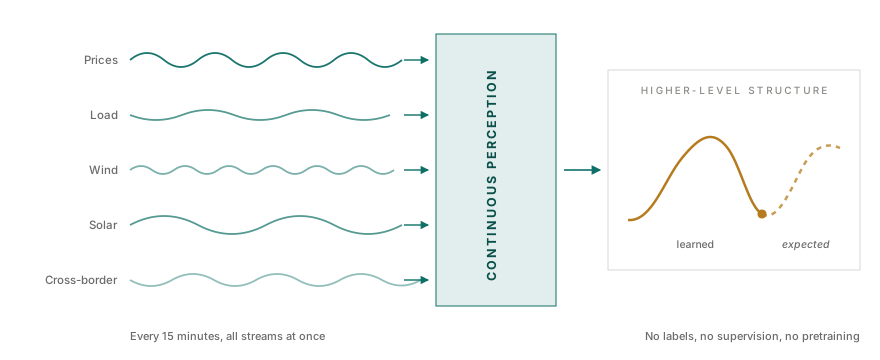
One component per stream. Each input stream has its own component that learns to forecast it, and nothing is trained centrally.
-
Experience is kept as memory. Forecasts and decisions are read from recorded situations and what followed them.
-
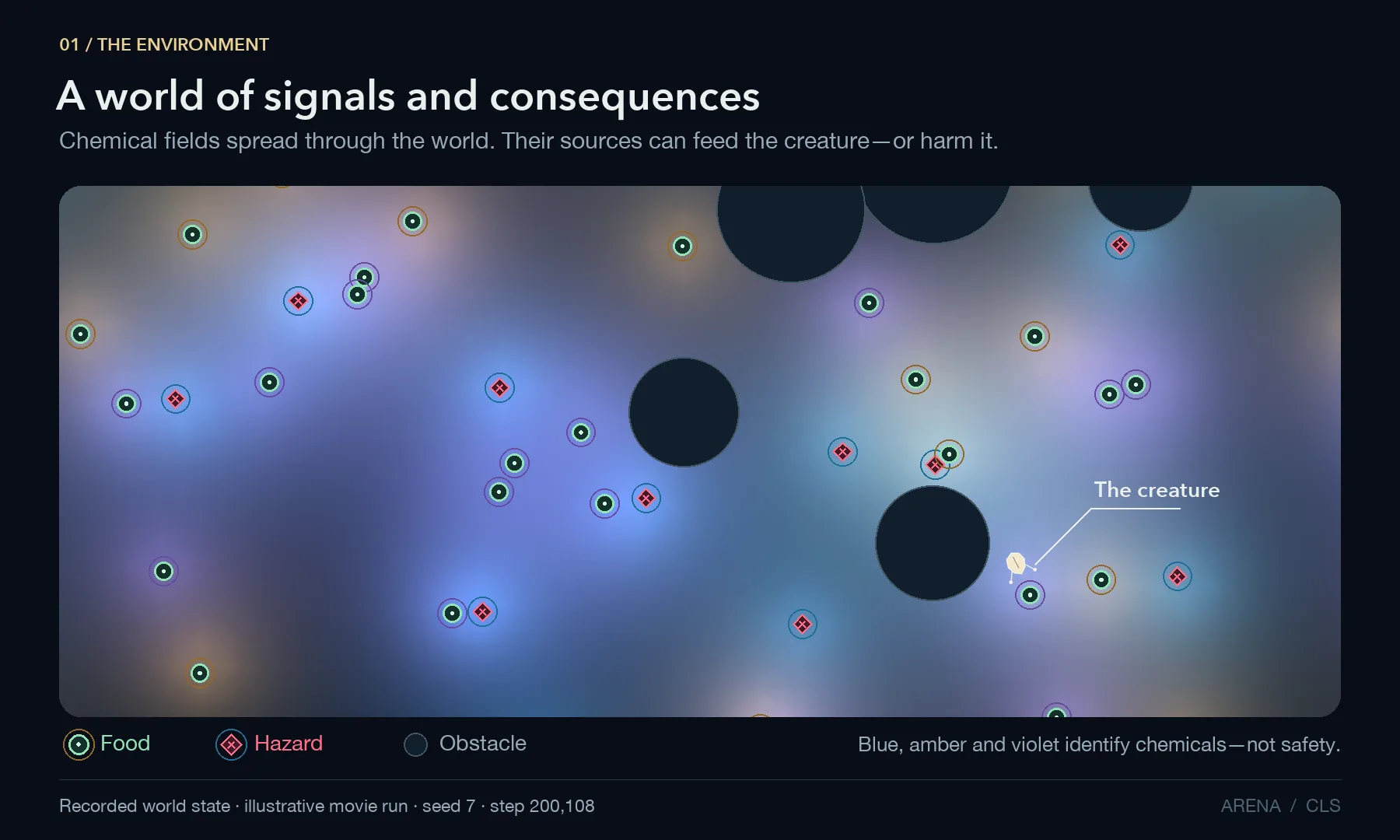
Consequences are the teacher. The next observation grades the previous prediction. To act, the system needs only a preference for larger outcomes.
-
Change is handled in memory. Old experience loses weight as new experience arrives, with no reset and no retraining.
-
No neural networks, no backpropagation, no GPU. Hundreds of live streams run on one CPU server.
Production
Evidence from continual learning systems running in production.
Empirical
Experiments with numbers, reported with their method and limitations.
Learning in Worlds| Date | Title | Environment | Compared against | Headline result | Tags |
|---|---|---|---|---|---|
| The CLS Forecasting Benchmark on the 15-Minute Market | Day-ahead power prices, 15-minute resolution | TabPFN 2.5 | 91.4% of the perfect-foresight battery revenue vs 89.8% for TabPFN 2.5 over the first year of 15-minute trading | ||
| Forecasting Traffic Without an Offline Training Phase | Real road sensors (PEMS-BAY, METR-LA) | DCRNN, Graph WaveNet | PEMS-BAY: lower mean absolute error than published DCRNN and Graph WaveNet at every horizon; METR-LA within 1.9–3.6% of the DCRNN checkpoint | ||
| Learning the Shape of a Rule It Was Never Shown | Simulated stock market, shaped rules | Tabular Q-learning | Recovered every committed rule shape (exemption, kink, cap, surcharge band) on three unseen seeds; tuned Q-learning failed the entry test | ||
| Learning while the world changes | Simulated road network | Its own control arms | With forecast input, 29 seconds saved per journey on average against a matched learner without it (8 runs, 3,200 scored journeys) | ||
| Keeping a Learned Rule Current When Nobody Announces the Change | Simulated stock market, changing rules | Q-learning | Registered every unannounced rule change and re-acquired each new rule (medians 70 and 294 trading days); Q-learning variants missed 3 and 14 | ||
| Learning a Hidden Cost Structure from Outcomes Alone | Simulated stock market | Tabular Q-learning | Recovered a hidden 25% capital-gains tax schedule from outcomes alone, within about 6% at every bounded level of gain | ||
| The CLS Forecasting Benchmark: Continual Learning Measured in Euros | Day-ahead power prices, hourly resolution | TabPFN, Prophet, NeuralProphet | ~14% higher cumulative trading P&L than TabPFN over 2,097 trading days |
No studies match these filters.
Theoretical
First-principles arguments and definitional work, with no new data.
Foundations
- Why Intelligence Exists - and What That Means for AI
Intelligence emerged to allocate limited resources more efficiently than competitors, and that origin is a lens for judging how AI systems learn.
- Why Generalization Is Not the Same as Intelligence
Breadth of knowledge is not the point: intelligence is about maintaining viable behaviour over time, coupled to consequence.
- Why Intelligence Evolved as a Prediction Mechanism
Intelligence is best understood as action-conditioned prediction under consequence, with implications for AI architecture.
- The Analog Nature of Intelligence
Biological intelligence emerged inside continuous signals and causal time; this essay asks what discrete machine learning assumes away.
- Why Intelligence Cannot Rely Only on What It Learned Before
Questions the quiet assumption that a trained model must already contain the knowledge needed for future problems.
- Why the Search for More General Intelligence Likely Requires an Idea Beyond Deep Learning
Representation alone is not enough: more general AI likely needs learning coupled directly to ongoing interaction with a changing world.
- Learning From the World Versus Learning About the World
Compares language models, world models and learning from interactive consequence as three routes to more general AI.
- Intelligence as a Temporal Process
Intelligence is a process with a temporal structure, defined by how a system relates to its own past, present and future.
Continual learning defined
- Continual learning: the missing half of AI
What continual learning is, why it matters, the evidence for it and how Wakeline builds it.
- What Continual Learning Actually Means - and What It Doesn't
Continual learning as a runtime property: selective adaptation under consequence, distinct from retraining cycles, scale or constant parameter drift.
- Stateful vs. Stateless Systems - Why the Distinction Matters for Artificial Intelligence
Intelligence needs continuity: a system that does not carry forward the consequences of experience has to relearn the same lessons.
Drift and change
- When the Rules Move
Prediction gets much harder when the underlying rules shift often, which makes continuous coupling to consequence an architectural necessity.
- When Change Happens: Understanding Drift in Learning Systems
Why learning systems fail when the world shifts faster than their assumptions: data drift, label drift and concept drift.
- Measuring What Moves: Evaluation and the Problem of Time in Learning Systems
Static benchmarks assume the system stands still while it is measured; continual learning needs evaluation that accounts for time and consequence.
Uncertainty
- Aleatoric and Epistemic Uncertainty in Continual Learning Systems
A system that updates itself over time cannot postpone uncertainty, so it has to be treated as a design constraint.
- Why General Intelligence Requires Tolerance for Uncertainty
Intelligence is not the elimination of uncertainty but the ability to act coherently within it.
Architecture and safety
- Separation Before Depth
Continual learning needs new and old knowledge kept architecturally separate, not only graduated over time.
- Why Weights Are the Wrong Place to Store Experience
Encoding everything a system learns into the structure it computes with conflates memory and inference, a problem scale cannot solve.
- What "Safe" Means for a System That Never Stops Updating
For a system that keeps learning, safety has to apply to the mechanism of change itself, not to a snapshot of present behaviour.