
We built this traffic demonstration to make Wakeline’s Continuous Learning System (CLS) visible: how does experience change a system’s decisions while it keeps operating? The film explores two connected ideas: learning from outcomes and learning to act on predictions.
First, a car crosses a simulated town with 16 junctions, choosing its next turn toward work. Four morning departures each simulated day share one learner. Roadworks disrupt a familiar route, and experience carries from one trip to the next.
Read the video transcript
Silent CLS demonstration, 2 minutes 17 seconds. The learning loop is illustrated; choices and travel times are recorded.
00–06 seconds : Same commute. Always learning.
One town. One destination. Experience informs the next decision.
06–15 seconds : The road changes.
Roadworks now run from 07:00 to 08:00. Follow one recorded 07:15 commute.
Recorded departure: 07:15, day 480. At the highlighted junction, the chosen direction is down toward the roadworks.
15–23 seconds : Observe the situation.
Place, time and traffic signals provide context. Past experience helps evaluate this situation.
Recorded departure: 07:15, day 480. At the highlighted junction, the chosen direction is down toward the roadworks.
23–30 seconds : Choose the next turn.
CLS compares the available directions. Here, it still prefers the road toward the works.
Recorded departure: 07:15, day 480. At the highlighted junction, the chosen direction is down toward the roadworks.
30–39 seconds : Experience the result.
The car takes that turn and meets the slowdown. Travel time becomes feedback.
The roadworks segment takes 4.27 minutes; shown after it has been driven.
39–48 seconds : Update before choosing again.
Feedback updates stored values for directions. This repeats after every road segment.
Simulator feedback also includes costs for unchosen alternatives.
The roadworks segment takes 4.27 minutes; shown after it has been driven.
48–54 seconds : The loop continues.
Four repeated trials per simulated day. Observe. Choose. Experience. Update.
54–65 seconds : Experience changes the choice.
Same junction. Same 07:15 departure. The upper road now ranks first.
Recorded combined preference: current context plus accumulated experience.
Recorded departure: 07:15, day 659. At the highlighted junction, the chosen direction is across the upper road.
65–72 seconds : Can it learn what comes next?
A separate controlled simulation begins. Two schematic routes connect home and work. The main road takes 32 minutes when clear; the bypass takes 36 minutes. Both roads are clear at departure. The challenge is to choose before traffic changes. The CLS core is unchanged; the test introduces a new forecast input.
72–81 seconds : A pattern becomes a warning.
CLS recognizes a pattern in earlier readings from a nearby sensor and predicts a slowdown ahead. The recent readings show speed loss rising from 20% to 35%, 50% and 65%. They are observed at 15, 10 and 5 minutes before departure, and at departure. A warning is available at departure, predicting slowdown onset 20 minutes ahead. The main road is still clear.
The two explanatory rows distinguish traffic patterns leading to forecasts, and journey outcomes informing future choices.
81–93 seconds : The warning is there. The choice lags.
Journey 11 is an early learning example. CLS receives the warning but still prefers and selects the main road. After a pause to explain the decision, the replay runs at six travel minutes per second. The actual slowdown starts five minutes after departure. The main-road journey takes 39 minutes 17 seconds. The forecast’s expected onset of +20 minutes and actual onset of +5 minutes remain visible.
Feedback follows at the end of the episode and includes simulated travel times for both routes.
93–99 seconds : More journeys. More experience.
A time jump advances from journey 11 to journey 434, 423 journeys later. Forecasting and choice learning continue. Observe patterns, make a forecast, choose a route, receive feedback. The learner keeps its existing state. The counter is a schematic compression of experience between selected records.
99–110 seconds : Same forecast. More experience.
In journey 434, CLS now prefers and selects the bypass. Its forecast input is identical to journey 11. The learned combined preference has changed. The two matched copies encounter the same traffic and both keep learning. CLS with forecast input chooses the bypass; CLS without forecast input chooses the main road. Both roads are still clear at departure.
110–126 seconds : The slowdown arrives later.
The teal car with forecast input takes the bypass. The gray car without forecast input takes the main road. A shared elapsed-time clock runs at four travel minutes per second. The actual slowdown starts after five minutes, earlier than the forecast’s estimate of 20 minutes. The warning is useful, but its timing is imperfect.
The main road has a clear 20-minute approach. Travel through its affected section follows the recorded changing speeds. Teal arrives in 36 minutes. Gray arrives in 39 minutes 17 seconds. This example saves 3 minutes 17 seconds.
126–137 seconds : Learning to predict. Learning to act.
Useful forecasts can improve choices. Learning to use them takes experience. Across eight runs, the mean saving is 29 seconds over 3,200 scored journeys, including quiet journeys. Each run first has 200 initial-learning journeys. Only 37% of accepted warnings lead to a bypass in the scored evaluation. Recognizing the pattern comes first; using it well takes more experience.
These results come from a controlled simulation with repeating patterns and feedback on both routes. The film is silent and contains no consumer-product ending. Choices, forecast records and travel times come from the experiments; maps, explanatory diagrams and time compression are illustrations.
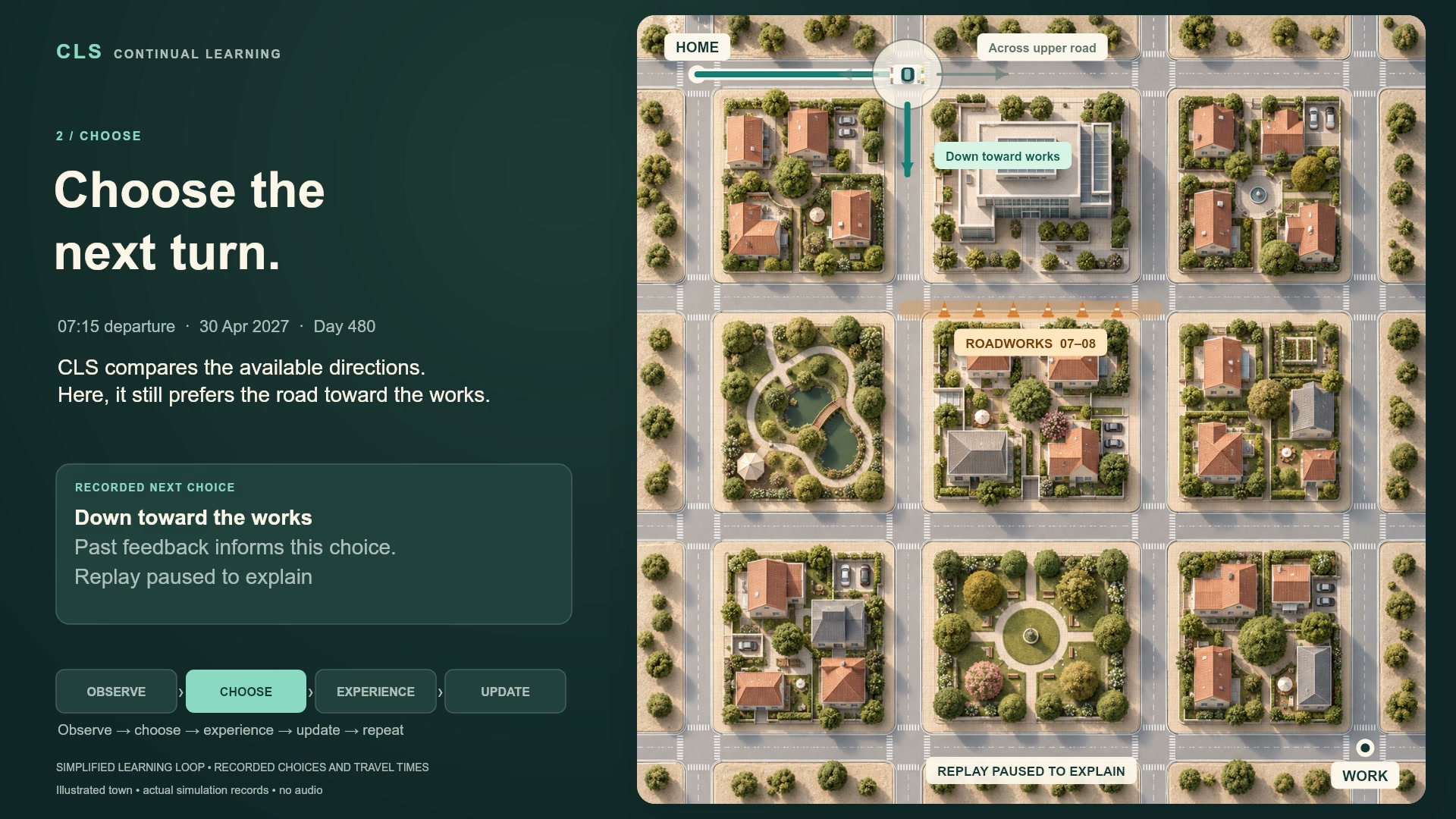
The four steps at the bottom explain the cycle: observe, choose, experience, update. CLS combines place, time and traffic with past experience. After each road segment, travel-time feedback updates future choices. At first, it still heads toward the works. After more trips, the upper road becomes its preferred turn at the same junction and departure time. The calendar jump compresses months of experience.
At 1:05, a separate, simpler simulation asks whether CLS can anticipate trouble. There are two routes: a main road taking 32 minutes when clear, and a bypass taking 36. Both are clear at departure. The challenge is to choose before the main road slows.
CLS learns patterns in traffic readings over time and uses them to anticipate what may happen next. Here, earlier readings from a nearby sensor provide a warning. The current reading alone cannot distinguish an approaching surge from a quiet journey. A new connection brings the forecast for the road ahead into the route decision, taking the car’s expected arrival time into account.
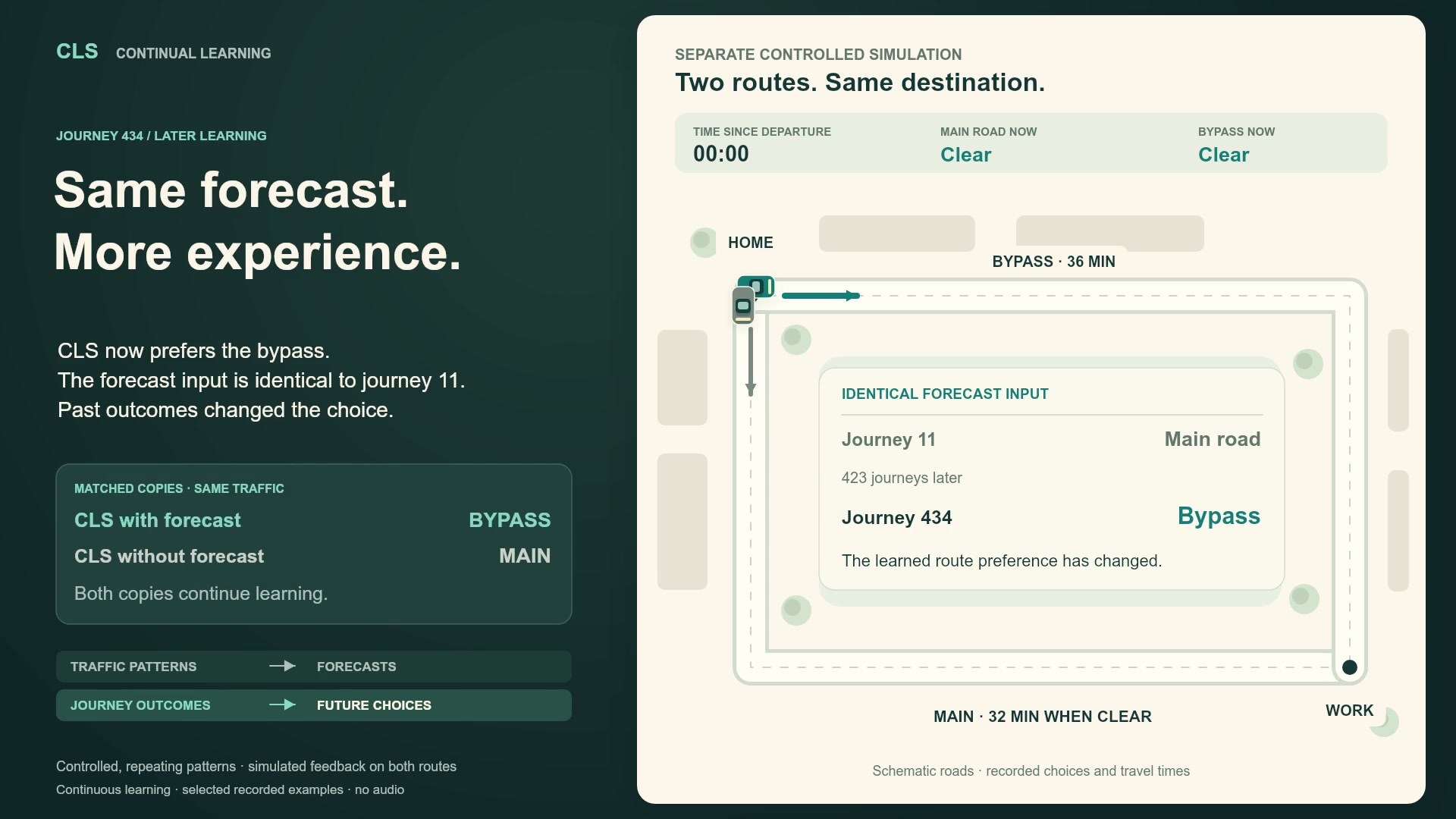
In journey 11, CLS already has the warning but still prefers the main road. By journey 434, the identical forecast input leads to a bypass. No rule tells it to detour whenever a warning appears. Outcomes gradually change how it evaluates the choice.
Learning to predict and learning to use a prediction are separate parts of the process. A useful forecast still leaves a decision to make. The bypass costs time when the main road stays clear, so CLS has to learn when a detour is worthwhile. This is the step from anticipating a problem to responding effectively: experience improves how CLS acts on a warning while the system keeps operating.
The teal and gray cars then make a matched comparison. Both copies keep learning; only teal receives the forecast input. Teal arrives in 36 minutes, gray in 39 minutes 17 seconds. The warning helps despite imperfect timing: it predicts a slowdown after 20 minutes, while the actual slowdown starts after five.
That example saves 3 minutes 17 seconds. Compared with the learning copy without forecasts, the average saving is 29 seconds across eight runs and 3,200 scored journeys after an initial learning period. Quiet journeys need no detour, and only 37% of accepted warnings lead to a bypass. Forecasting develops before route choices fully catch up.
Transferring CLS to traffic involved both reuse and adaptation. The prediction logic carried over, as did the ways CLS balances initial preferences with experience and explores alternatives. We built a new traffic environment and interface, changed the available actions and inputs, and adapted how journey outcomes influence decisions and how stored experience is retrieved at each junction. These were meaningful changes to the traffic system’s decision and learning behavior.
For the later anticipation test, we reused this already-adapted traffic CLS core unchanged and added the new test setup and forecast connection. The result shows how established learning mechanisms can support a new task once the surrounding system supplies relevant information.
These are controlled simulations, not real-traffic performance estimates. The anticipation test uses simple, repeating patterns. Feedback includes simulated travel costs for both chosen and unchosen alternatives; in the anticipation test it arrives after each episode.